
The Grammar of Proof and the Vanishing of Presence
When Science Renames a Practice
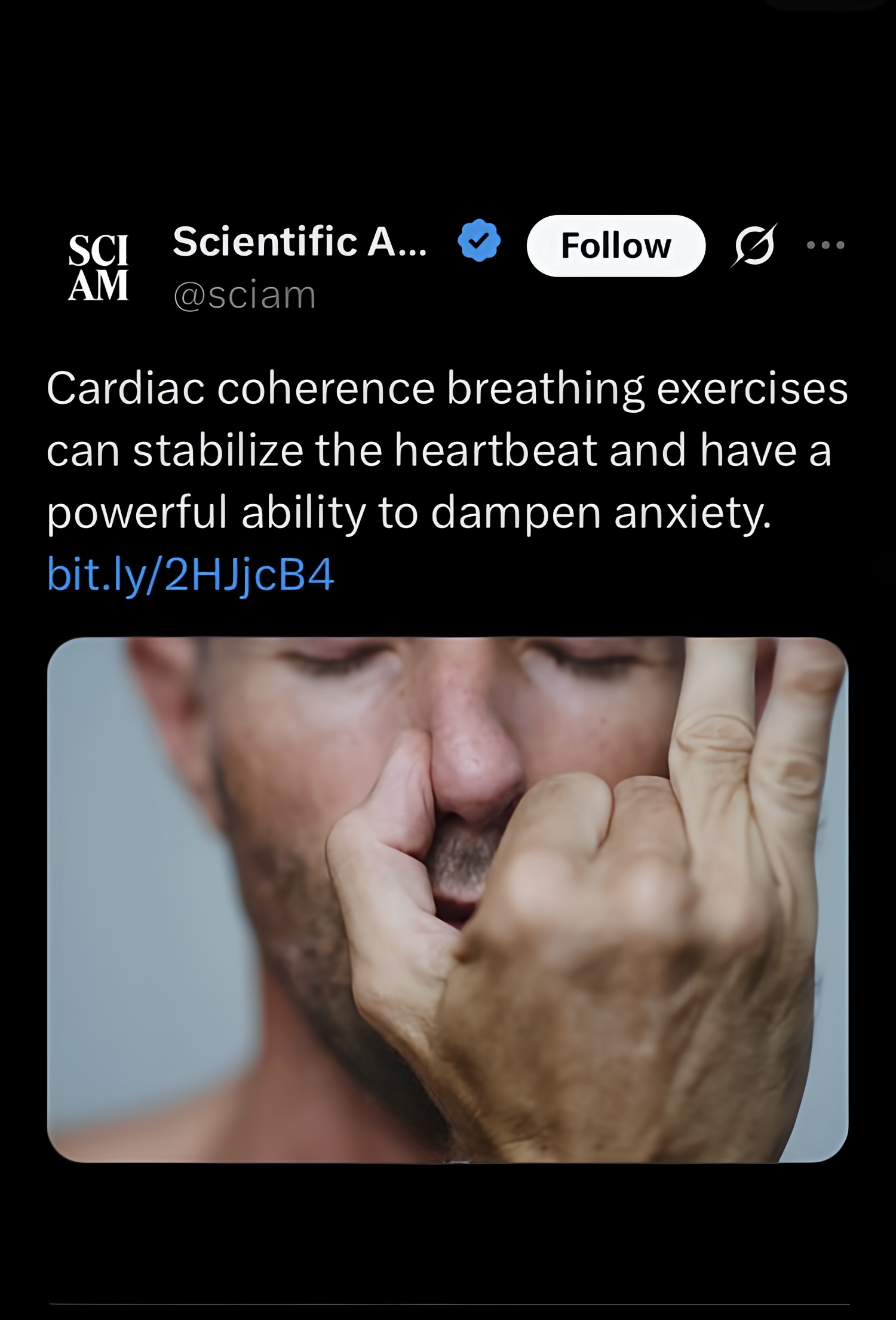
A photograph in Scientific American shows a man seated in profile, one hand closing a nostril while the other rests on his knee. The caption names the act “cardiac coherence breathing,” a method said to stabilise heart rhythm and reduce stress. The image appears unremarkable, its authority grounded in measurement and clinical neutrality. Yet the gesture is ancient.
Across South and East Asia, comparable forms of breath cultivation have existed for centuries. They were never conceived as exercises in regulation but as acts of correspondence, binding perception to the movement of the world. Breath was not a subject for study but a medium of participation, joining inner awareness to the larger rhythm of life.
When the same act is placed within the vocabulary of physiology, its nature changes. The motion of the body is identical, but its meaning is rewritten. Regulation replaces cultivation, observation replaces participation. A process once understood as the refinement of attention becomes a technique for managing function. The modern vocabulary does not merely describe; it redefines.
This transformation reveals a deeper condition of the modern intellect, a shift from lived understanding to the logic of verification. Knowledge has come to mean that which can be tested and repeated. The act of seeing, once relational, has become detached, assuming that truth lies in distance rather than involvement. In this world, breath, touch, and thought are valid only when rendered into data.
The photograph captures more than a change of terminology. It records the passage from immediacy to validation, from experience to record. What it portrays as a technique, earlier cultures regarded as a way of attunement. Both claim care for life, but one seeks control while the other seeks coherence. Within that difference lies an entire reorganisation of knowledge.
The image stands as an emblem of modern authority, a world where meaning survives only through quantification, and where what cannot be measured loses reality.
The Reformation of Chinese Medicine
This movement from participation to verification was not confined to the West. When China sought to modernise its own medical heritage in the mid-twentieth century, Classical Chinese Medicine, an intricate network of cosmology, moral philosophy, and clinical discernment, was consolidated into a system the state could regulate and the world could recognise. Traditional Chinese Medicine was born.
The new structure preserved the vocabulary of the old but altered its grammar. Apprenticeship was replaced by curriculum, transmission by standardisation. Where healers had once spoken of resonance, correspondence, and qi, institutions now spoke of efficacy and method. The reform was not purely political; it reflected a desire to participate in global science. Yet in achieving recognition, the practice was made legible to the very framework that would later appropriate it.
Within this reorganisation lies the prototype of the modern dilemma. To enter the language of validation, a tradition must first relinquish the conditions of its own understanding. What remains appears scientific but no longer describes the same world.
The Trial as Translation
When healing was reorganised within the logic of the modern laboratory, its meanings were detached from the networks of relation that had sustained their coherence. A formula could be removed from its setting, reconstituted as an object of control, and displayed as evidence. The act of translation appeared empirical but functioned as a declaration of epistemic authority. It affirmed that knowledge derives from isolation rather than participation.
When the practices of Classical Chinese Medicine entered clinical research, this displacement reached its apex. The pulse, once read as a living exchange between body and climate, became a numerical waveform. The herbal prescription, once refined through intuition and cosmological discernment, was recast as a biochemical event. Adaptation turned to extraction, and the gesture of interpretation was replaced by measurement. The world that had once sustained these acts was erased so that their remnants might appear measurable.
A clinical trial can confirm efficacy but not coherence. It can record improvement but not the relational intelligence that makes healing possible. Within the trial, the patient becomes data and the practitioner a functionary of compliance. The shared field that once united both within a cosmology is replaced by procedural neutrality.
This ritual of validation enshrines a new orthodoxy. It treats reduction as revelation and loss as progress. Success is defined not by the depth of discernment but by conformity to the method that dictates it. To examine qi, it must first be renamed as energy. To test spirit, it must be redefined as stress. What survives this process is residue, stripped of context until it mimics understanding.
The laboratory narrows knowledge even as it claims to extend it. Its prestige lies in the spectacle of certainty, maintained by exclusion. What escapes its instruments is deemed peripheral, and what remains is presented as the totality of truth.
Through this performance, science mistakes selectivity for discernment. It displays fragments of other worlds as if they were trophies of comprehension. Yet what it claims to have examined, it has scarcely apprehended. The reduction of living systems to variables, and of meaning to function, marks not enlargement but impoverishment. What emerges from the trial is not knowledge but its simulacrum.
Therapy as Extraction
The modern search for legitimacy in medicine has its counterpart in psychology. The same criteria that turned herbal prescriptions into data have turned inwardness into method. When science began to study consciousness, it applied the same instruments of verification that had defined its study of matter. The result was not a continuation of older introspective traditions but their reconstruction within the limits of what could be measured, replicated, and applied.
Meditation, long treated across Asian traditions as a moral and perceptual discipline, was redefined as a form of attention training. The depth of its philosophical structure, its concern with impermanence, selfhood, and liberation, was replaced by a vocabulary of stress reduction and cognitive control. In this translation, the practitioner became a subject of experiment, and the act of meditation a method of behavioural regulation. What had been a path of understanding was recast as a procedure for psychological management.
The same pattern extends through the field of somatic psychology. Twentieth-century therapists began to describe the body as a site of emotion, tension, and release, often presenting this as new insight. Yet forms of embodied awareness and internal observation had long existed in the monastic, medical, and ritual contexts of Asia. Their purpose was not catharsis but attunement, the refinement of perception until sensation and consciousness became continuous. When these methods entered the therapeutic lexicon, their ethical and cosmological frameworks were omitted. What remained was a method detached from the world that had given it meaning.
This translation also carried economic consequence. In the clinical sciences, legitimacy arises from citation and funding; in psychotherapy, it arises from certification. The institutions that decide what counts as credible practice also own the means through which that credibility is purchased. Training schools, credentialing bodies, and academic departments reproduce the same structure of authority that governs medical research. Profit follows endorsement, and endorsement follows compliance with the prevailing logic of validation.
Through this process, psychology mirrored the asymmetry already entrenched within modern medicine. The observer replaced the participant, the measured replaced the lived, and consciousness itself became a field to be administered. A discipline that once sought to dissolve the boundaries of the self now sustains an industry built upon them. The knowledge of inner life, once transmitted through lineage and contemplation, survives only in fragments that can be certified.
The Aesthetic of Proof
In the modern world, authority resides not only in data but in its presentation. The image, the graph, and the citation form a grammar of persuasion that makes the measurable appear self-evident. The page of a medical journal or the frame of a documentary carries a visual order that mirrors the moral order of science. What appears structured therefore seems true.
When traditional practices are represented within this aesthetic, their meanings are altered long before their methods are examined. A practice once transmitted through gesture and presence becomes a diagram. Its value lies in the symmetry of its depiction rather than the coherence of its worldview. The photographic reproduction of an acupuncture chart or the rendering of a meridian system in digital blue confers an aura of neutrality. It persuades by appearing detached from belief, even as it enforces a new one: that what cannot be diagrammed does not exist.
This aesthetic of proof transforms not only how knowledge is received but how it is conceived. To attract recognition, a practice must learn the syntax of the measurable. A clinical trial must be visualised, a result must be graphed, a phenomenon must be formatted for citation. The medium determines what can be known. Through these forms, the language of verification extends beyond laboratories into classrooms, health columns, and screens.
Media institutions amplify this shift by rewarding clarity over context. When a traditional medicine appears on the front page or a wellness influencer’s feed, it must conform to the visual and rhetorical codes of accessibility. The complexity of its cosmology is replaced by aesthetic minimalism. The public is invited to admire the technique, not to question the framework that defines it. The visual field becomes a filter through which ancient knowledge is continuously simplified, its cultural custodians rendered invisible.
Such representation carries moral consequence. What the image verifies, the culture authorises. The same mechanisms that legitimise scientific discovery also determine what counts as civilisation. The gaze that claims to record without bias reproduces the hierarchy that made its distance possible. In this order of things, the appearance of objectivity becomes the highest proof of power.
Through the aesthetic of proof, the modern eye learns to trust what has been abstracted from its world. The diagram replaces the lineage, the citation replaces the voice, and the observer, trained to see from nowhere, equates distance with truth. The image of neutrality becomes the substance of authority.
Custodianship and Silence
Every system of knowledge has its keepers. In the older world, authority rested in proximity: the apprentice learned through transmission, not ownership. The teacher carried not only method but moral responsibility for the integrity of the teaching. Knowledge lived in relation rather than possession.
When the structures of science and media absorbed Eastern disciplines, they also absorbed their authority. The transfer was subtle but complete. A form of expertise once grounded in lineage was replaced by institutional endorsement. The credential became the modern lineage, and the university its monastery. To teach, one needed not recognition from a master but approval from a board. Custodianship, once personal, became bureaucratic.
This transposition redefined silence. Within traditional frameworks, silence held meaning. It was the pause in which understanding matured, the mark of humility before the unseen. In the contemporary academy, silence has another function: it erases those who no longer possess the means to publish. The absence of citation is mistaken for the absence of thought. The result is not ignorance but misattribution. The insight of the practitioner is rewritten as the innovation of the researcher, and the lineage fades from view.
What remains unspoken becomes unowned. The ritual knowledge of medicine, the intuitive reading of pulse and breath, the lived comprehension of the body as cosmos, are treated as pre-scientific remnants awaiting rescue by a more enlightened system. The voice of the custodian is tolerated as anecdote but excluded as authority. This exclusion does not require hostility; it operates through polite omission.
The rhetoric of inclusion, often invoked to disguise this omission, completes the cycle of appropriation. Diversity initiatives invite representation but not power. They seek cultural presence without epistemic consequence. The custodian may be invited to speak but not to define. The form of dialogue remains, yet the grammar of hierarchy endures.
In the absence of real reciprocity, silence takes on another tone. It is no longer the contemplative stillness of insight but the muting of context. What was once a pause becomes a gap, a vacuum filled by reinterpretation. Within that space, the modern expert rises, fluent in the vocabulary of proof but deaf to the resonances that once gave meaning to practice.
The moral question is therefore not who is allowed to teach, but who is allowed to mean. To restore custodianship is to restore the conditions in which meaning survives translation. Without this, knowledge remains mobile yet unmoored, a collection of techniques wandering from their worlds.
Restoring the Ground of Meaning
If knowledge is to recover coherence, it must learn again to recognise its own conditions. The separation between the observer and the observed, between the experiment and the world, has been treated as a mark of progress. Yet this distance has become the very source of distortion. What began as a method for precision evolved into a habit of estrangement, a way of seeing that renders all other ways subordinate. The restoration of meaning therefore begins not with reclamation but with remembering: recalling that knowledge once implied belonging.
Restoration does not require the rejection of science, only the refusal to accept it as the sole arbiter of truth. There are other grammars of understanding, ritual, intuition, aesthetic discernment, that describe the same world through different coordinates. To recover these is not to depart from reason but to recognise that perception is not confined to what can be measured. The continuity between mind and world is not a relic of pre-scientific thought; it is the condition of experience itself.
In the context of medicine, this recognition demands more than the revival of technique. It calls for a return to relational awareness, the understanding that healing occurs within a field of meaning as much as within a body. When the practitioner becomes once again a participant rather than an analyst, the patient ceases to be an object of treatment and becomes a locus of correspondence. The act of diagnosis becomes an act of listening, and the body regains its role as a medium of relation rather than a site of repair.
This reorientation extends to education. The challenge is not to add courses on alternative medicine or cultural literacy but to question the epistemic infrastructure that defines what counts as credible knowledge. To teach medicine, psychology, or philosophy without reference to their conditions of emergence is to teach half a world. When curricula acknowledge that the modern categories of science, mind, and matter are historically produced, students begin to see that other frameworks were not errors but alternate orders of truth.
Media too must learn to see differently. Its task is not to translate every practice into digestible form but to represent without erasure. The test of an ethical image lies not in clarity but in fidelity, to show without claiming ownership. When coverage of traditional practices includes their histories of transmission and exclusion, representation becomes an act of repair. The frame expands until it can hold the world from which the image was taken.
The ground of meaning cannot be restored through policy or reform alone. It requires a shift in temperament, from the ambition to prove toward the patience to understand. Cultures endure not because they resist change but because they remember the relations that sustain them. If the modern world has learned to see everything as data, then the next task is to learn again to see through relation. Only then can knowledge cease to be an instrument of extraction and become once more a form of participation.
© Kim U-Ming, 2025. Originally published on Medium and Substack. This work is part of a larger body of thought. Please do not excerpt, reframe, or republish without express written permission.